
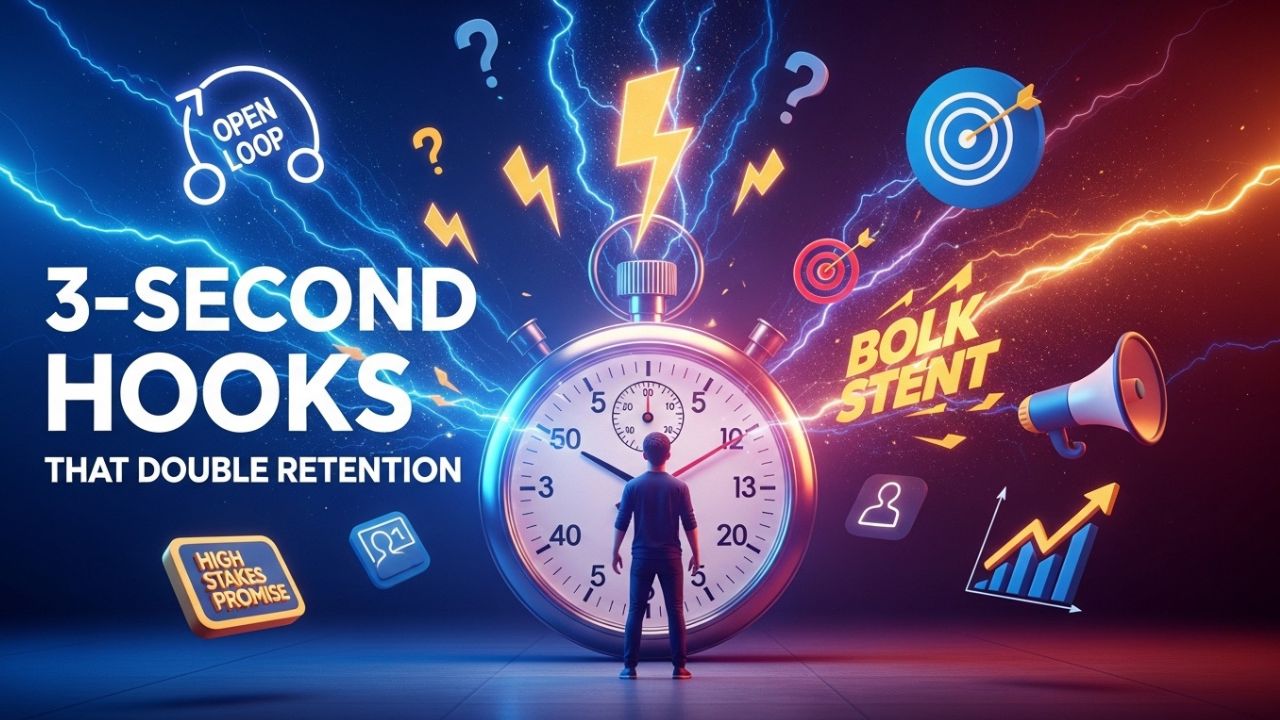
In today’s digital ecosystem, attention is not just scarce—it is the most valuable currency on the planet. Every scroll, swipe, tap, and click represents a decision. A micro-decision. And those decisions are made in seconds—often less than three.
Three seconds.
That’s the average window you have to convince someone not to scroll past your video, skip your content, close your tab, or ignore your message.
If you win those three seconds, you dramatically increase the probability of winning the next thirty. And if you win the first thirty, you stand a real chance of earning minutes.
Retention is not random. It’s engineered.
This article will explore five powerful 3-second hooks that can literally double your retention when used strategically. We’ll break down:
- The psychology behind each hook 🧠
- When to use it
- Why it works
- Examples across platforms
- Mistakes to avoid
- A comparative framework
- Practical implementation steps
By the end, you won’t just understand hooks—you’ll be able to build them systematically.
Why the First 3 Seconds Matter So Much 🔥
Before we jump into the five hooks, we need to understand why the first seconds matter so disproportionately.
The Attention Curve
When someone encounters your content, their brain rapidly asks:
- Is this relevant to me?
- Is this worth my time?
- Is this different from everything else?
If you fail to answer those questions immediately, their brain conserves energy by disengaging.
The Cognitive Science Behind It 🧠
- The brain is a prediction machine. It constantly predicts what comes next.
- When something is predictable → it disengages.
- When something is surprising → dopamine spikes.
- Dopamine increases focus and retention.
Your hook must interrupt autopilot.
The Retention Multiplier Effect
Retention works exponentially.
| Initial Retention | After 30 Seconds | Completion Rate |
|---|---|---|
| Weak Hook (20%) | 8% | 3% |
| Strong Hook (40%) | 25% | 12% |
Doubling first-3-second retention doesn’t just double your views—it can quadruple completion rates.
That’s the leverage.
Now let’s explore the five hooks.
Hook #1: The Pattern Interrupt ⚡
What It Is
A pattern interrupt is anything that breaks the viewer’s expectations immediately.
Humans operate on patterns. When scrolling, the brain expects:
- Similar thumbnails
- Similar tones
- Similar intros
- Similar pacing
When you disrupt the pattern, attention spikes.
Why It Works
The brain is wired to detect anomalies. From an evolutionary perspective, anomalies could mean danger or opportunity.
Anything unusual forces the brain to ask:
“Wait. What was that?”
That moment of pause is your entry point.
Types of Pattern Interrupts
| Type | Example | Where It Works Best |
|---|---|---|
| Visual Shock | Sudden zoom, unexpected object | Short-form video |
| Verbal Shock | “Stop scrolling.” | Social feeds |
| Emotional Contrast | Calm voice → sudden urgency | YouTube intros |
| Environmental Shift | Unusual background | Educational content |
| Silence | 1-second pause before speaking | Podcasts & video |
Examples
Instead of:
“Today I’m going to teach you about productivity…”
Try:
“This one habit is secretly destroying your productivity.”
Or even stronger:
“You’re doing productivity wrong.”
That’s a pattern break.
Another example:
Video opens with someone mid-sentence:
“…and that’s why most people fail before they even begin.”
No introduction. No greeting.
Instant curiosity.
How to Build It Step-by-Step
- Analyze your niche.
- Identify the most common intro pattern.
- Do the opposite.
If everyone says:
“Hey guys, welcome back…”
You start with:
“If this sounds like you, we need to talk.”
Mistakes to Avoid 🚫
- Being shocking without relevance.
- Clickbait that doesn’t pay off.
- Overusing dramatic effects.
Pattern interrupts should serve curiosity, not replace substance.
Hook #2: The Open Loop (Curiosity Gap) 🧩
What It Is
An open loop is an incomplete idea that creates tension in the brain.
Humans hate unfinished narratives. We crave closure.
If you start something but don’t finish it, the brain wants resolution.
Why It Works
The Zeigarnik Effect states that people remember unfinished tasks better than completed ones.
Unresolved information creates cognitive tension.
That tension equals retention.
Simple Formula
Tease outcome + delay explanation
Example:
“I changed one tiny thing in my routine, and it doubled my income.”
Now the viewer wants to know:
- What was the thing?
- How did it work?
- Can I replicate it?
They stay.
Advanced Open Loop Strategy
Instead of revealing the answer immediately, layer the loop.
Example structure:
- Big claim.
- Context story.
- False assumption.
- Reveal twist.
- Payoff.
This keeps dopamine active.
Table: Weak vs Strong Open Loops
| Weak | Strong |
|---|---|
| “Let me tell you a story.” | “This mistake cost me $50,000.” |
| “I learned something interesting.” | “I ignored this advice for 5 years. That was a mistake.” |
| “Here’s a tip.” | “Most people get this completely wrong.” |
Where It Works Best
- YouTube videos 🎥
- Webinars
- Sales pages
- Email subject lines
- Story-based content
Mistakes to Avoid
- Never closing the loop.
- Opening too many loops.
- Making vague promises.
Curiosity must feel specific.
Hook #3: The Identity Call-Out 🎯
What It Is
An identity hook directly calls out a specific group of people.
Instead of talking to everyone, you talk to someone.
Why It Works
Humans are tribal.
When someone hears their identity called, their brain flags it as relevant.
Examples:
- “If you’re a freelancer…”
- “Founders, listen up.”
- “Parents of teenagers…”
Relevance equals retention.
The Psychology of Identity
People don’t just consume content—they protect their self-image.
If your hook implies:
“Smart entrepreneurs do this…”
You trigger ego alignment.
No one wants to feel left out.
Table: Identity Variations
| Type | Example | Emotional Trigger |
|---|---|---|
| Aspirational | “Future millionaires…” | Ambition |
| Pain-Based | “If you’re tired of being overlooked…” | Frustration |
| Professional | “Designers, stop doing this.” | Competence |
| Stage-Based | “If you’re just starting out…” | Belonging |
| Contrarian | “High achievers avoid this.” | Superiority |
Example
Instead of:
“Here’s how to grow on social media.”
Say:
“If you’re trying to grow on social media and it’s not working, this is why.”
The second feels personal.
How to Build an Identity Hook
- Define your ideal viewer.
- Identify their internal struggle.
- Call them out directly.
Example formula:
If you are [identity] and you struggle with [problem], this is for you.
Mistakes to Avoid 🚩
- Being too broad (“Everyone who…”).
- Being insulting.
- Being unclear about who it’s for.
Clarity beats cleverness.
Hook #4: The Bold Contrarian Statement 💥
What It Is
A strong statement that challenges common belief.
It creates friction.
And friction creates attention.
Why It Works
The brain loves debate.
When someone hears something that contradicts their belief, they:
- Lean in.
- Prepare to argue.
- Engage cognitively.
That engagement boosts retention.
Examples
“Motivation is useless.”
“Hard work won’t make you rich.”
“Networking is overrated.”
These statements demand explanation.
Table: Contrarian Strength Levels
| Level | Example | Risk |
|---|---|---|
| Mild | “Morning routines aren’t for everyone.” | Low |
| Medium | “Morning routines are a waste of time.” | Moderate |
| High | “Productivity advice is a scam.” | High |
The stronger the claim, the stronger the hook—but also the greater the backlash.
Structure for Safety
- Bold claim.
- Clarify context.
- Provide reasoning.
- Deliver nuance.
Without nuance, you lose credibility.
When to Use It
- Opinion-based content
- Educational myths
- Industry critiques
- Thought leadership
Mistakes to Avoid
- Being controversial just to trigger.
- Lacking data or reasoning.
- Overusing outrage.
Authenticity sustains retention.
Hook #5: The High-Stakes Promise ⏰
What It Is
A specific, outcome-driven promise with urgency.
It implies:
“Stay, and something valuable will happen.”
Why It Works
Humans are wired for reward prediction.
If the reward feels big and attainable, attention locks in.
Example
Weak:
“I’ll share some tips.”
Strong:
“In the next 60 seconds, I’ll show you how to save 10 hours this week.”
Now there’s:
- Time constraint
- Measurable outcome
- Clear value
Table: Weak vs High-Stakes Framing
| Weak Framing | High-Stakes Framing |
|---|---|
| “Improve your writing.” | “Write 2x faster starting today.” |
| “Get in shape.” | “Lose your first 5 pounds safely.” |
| “Be more confident.” | “Stop overthinking in conversations.” |
Specificity multiplies retention.
The Math of Promise Strength 📊
Strong promises include:
- A number
- A time frame
- A measurable outcome
- A clear target audience
The more concrete the promise, the more compelling it feels.
Mistakes to Avoid
- Unrealistic promises.
- Vague metrics.
- Not delivering.
Retention gained dishonestly destroys long-term growth.
Combining Hooks for Maximum Impact 🔗
The real power happens when you combine hooks.
Example Combo
“If you’re a creator stuck under 1,000 followers, you’re making this mistake.”
This combines:
- Identity call-out
- Implicit contrarian statement
- Open loop
Or:
“Stop posting every day. It’s hurting your growth.”
That’s:
- Pattern interrupt
- Contrarian claim
Advanced Hook Stacking Framework
| Layer | Purpose |
|---|---|
| Layer 1 | Pattern interrupt |
| Layer 2 | Identity call-out |
| Layer 3 | Open loop |
| Layer 4 | High-stakes promise |
The first 3 seconds can contain multiple psychological triggers.
Platform-Specific Adaptation 📱
Different platforms reward different hooks.
| Platform | Best Hook Type | Why |
|---|---|---|
| TikTok | Pattern Interrupt | Fast scroll speed |
| YouTube | Open Loop | Longer viewing intent |
| Instagram Reels | Identity + Bold Claim | Personal relevance |
| Contrarian Thought | Professional debate | |
| High-Stakes Promise | Subject line impact |
Adaptation matters.
The Emotional Layer ❤️
Hooks are not just structural. They’re emotional.
Every strong hook triggers at least one:
- Fear
- Curiosity
- Hope
- Status
- Urgency
- Belonging
If your hook has no emotional charge, it won’t stick.
Testing and Optimization 🔬
Retention is measurable.
Look at:
- Drop-off at 3 seconds
- Drop-off at 10 seconds
- Average watch time
If 60% drop in first 3 seconds → hook problem.
If strong start but drop at 20 seconds → delivery problem.
Iterate hooks independently from content.
Hook Writing Formula Cheat Sheet 📝
Pattern Interrupt
“You’re doing this wrong.”
Open Loop
“This mistake almost ruined me.”
Identity
“Freelancers, read this.”
Contrarian
“Consistency is overrated.”
High Stakes
“In 2 minutes, you’ll understand this completely.”
The Ethical Dimension ⚖️
With great psychological power comes responsibility.
Manipulative hooks create short-term retention and long-term distrust.
Ethical hooks:
- Reflect real value.
- Deliver on promises.
- Respect the viewer’s time.
Sustainable growth depends on trust.
The Retention Flywheel 🔄
Strong hook →
Higher watch time →
Algorithm boost →
More impressions →
More data →
Better refinement →
Stronger hooks.
It compounds.
Final Thoughts: Mastering the First Three Seconds 🌟
The first three seconds are not an introduction.
They are a battlefield.
They determine:
- Whether your message spreads.
- Whether your brand grows.
- Whether your work gets seen.
The five hooks that double retention are:
- ⚡ Pattern Interrupt
- 🧩 Open Loop
- 🎯 Identity Call-Out
- 💥 Bold Contrarian Statement
- ⏰ High-Stakes Promise
When used intentionally, they transform content performance.
Not because they manipulate.
But because they align with how the human brain works.
Attention is not luck.
It’s design.
And now, you know how to design it.
Leave a Reply