
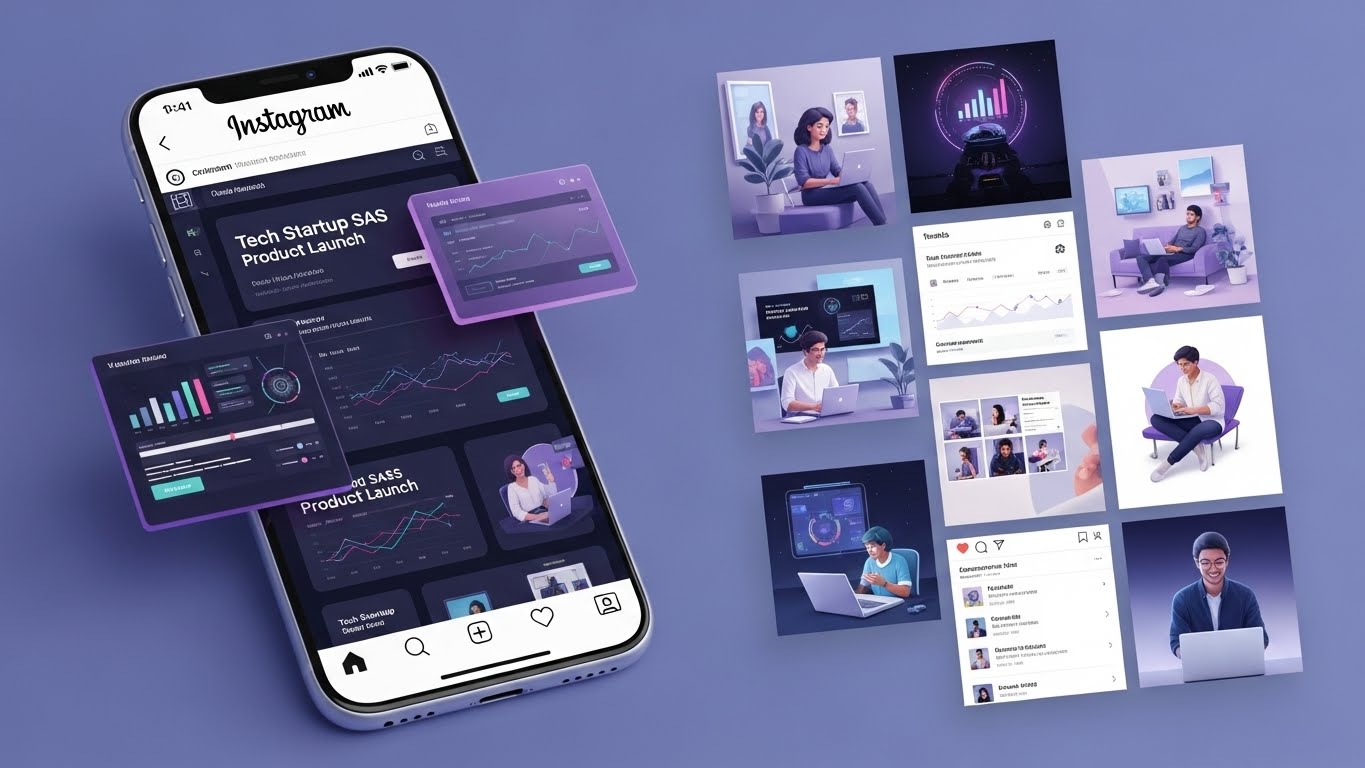
In the fast-paced world of technology startups, product launches are not just announcements—they are defining moments. A successful launch can attract early adopters, investors, partners, and media attention. A weak launch, on the other hand, can cause even a great product to fade into obscurity. Among all digital platforms available today, Instagram has become one of the most powerful channels for tech startups to tell their story, demonstrate value, and build momentum.
Instagram is no longer just a photo-sharing app. It has evolved into a full-scale content ecosystem that combines short-form video, long-form storytelling, live interaction, community building, and social commerce. For tech startups—especially those launching SaaS products, mobile apps, AI tools, hardware devices, or developer platforms—Instagram provides a unique mix of visual storytelling and human connection.
This article explores how tech startups can use Instagram effectively for product launch content. It goes beyond surface-level tips and dives deep into strategy, content formats, storytelling frameworks, posting timelines, metrics, and common mistakes. Whether you are a founder, growth marketer, product manager, or content creator, this guide will help you design Instagram content that supports a high-impact product launch.
Throughout this article, you will find:
- Practical frameworks for launch storytelling
- Content ideas tailored to different startup stages
- Tables to help with planning and execution
- Examples of captions, hooks, and calls to action
- Strategic use of emojis to enhance engagement 😄🔥
Let’s begin by understanding the strategic role Instagram plays in the product launch journey.
1. The Strategic Role of Instagram in a Tech Startup Launch
1.1 Instagram as a Pre-Launch Awareness Engine
Before a product ever goes live, Instagram can be used to build curiosity and anticipation. Unlike traditional press releases or blog posts, Instagram allows startups to tease features, hint at benefits, and involve the audience in the journey.
Key advantages of Instagram in the pre-launch phase include:
- Visual storytelling that simplifies complex technology
- Short feedback loops through comments, polls, and DMs
- Algorithmic discovery through Reels and Explore
- Emotional connection with founders and team members
For early-stage startups, Instagram often becomes the first public-facing brand channel, shaping how the product is perceived long before users interact with it.
1.2 Instagram During Launch Week
Launch week is where Instagram truly shines ✨. Stories, Reels, Lives, and feed posts can work together to create a sense of urgency and excitement. Unlike static platforms, Instagram supports real-time communication, making it ideal for:
- Live demos
- Feature reveals
- Customer reactions
- Founder announcements
- Countdown campaigns
A coordinated Instagram launch can feel like an event rather than a simple update.
1.3 Instagram as a Post-Launch Growth Channel
After launch, Instagram helps startups:
- Educate users
- Reduce churn through onboarding content
- Highlight use cases and integrations
- Collect testimonials and social proof
Product launch content does not stop on launch day—it evolves into adoption and retention content.
2. Understanding Your Audience on Instagram
2.1 Who Are You Really Talking To?
Many tech startups fail on Instagram because they speak in overly technical language or assume their audience has the same knowledge level as the product team. Before creating launch content, it is essential to define:
- Primary users (developers, marketers, founders, enterprises, consumers)
- Secondary audiences (investors, media, partners)
- Emotional drivers (fear of missing out, efficiency, status, innovation)
Instagram users scroll fast. Your content must instantly communicate relevance.
2.2 Mapping Audience Needs to Content Types
Different audience segments respond to different content formats. The table below illustrates how to align audience needs with Instagram content:
| Audience Type | Main Concern | Best Content Formats | Example Angle |
|---|---|---|---|
| Developers 👨💻 | Performance, APIs | Reels, Carousels | “How our API reduces latency by 40%” |
| Founders 🚀 | Growth, speed | Stories, Lives | “Launching faster with fewer resources” |
| Marketers 📈 | ROI, automation | Reels, Tutorials | “Automate campaigns in 3 steps” |
| Consumers 📱 | Ease of use | Reels, UGC | “From signup to success in 60 seconds” |
Understanding this mapping allows you to craft content that resonates instead of overwhelms.
3. Core Content Pillars for Product Launches
A successful Instagram launch strategy is built around content pillars. These are recurring themes that guide what you publish before, during, and after launch.
3.1 The Four Essential Launch Content Pillars
- Problem Awareness 😣
- Product Solution 🧠
- Social Proof & Trust 🤝
- Vision & Future 🌍
Let’s explore each in detail.
3.2 Problem Awareness Content
Before people care about your product, they must care about the problem it solves. Problem-awareness content focuses on:
- Pain points
- Inefficiencies
- Frustrations
- Cost of inaction
Examples:
- “Still using spreadsheets for this in 2025?” 😬
- “What happens when your infrastructure doesn’t scale?”
These posts perform especially well as Reels and Carousels.
3.3 Product Solution Content
This pillar introduces your product as the answer—but without turning every post into an ad. Effective solution content:
- Shows outcomes, not just features
- Uses simple language
- Demonstrates real scenarios
Example Reel ideas:
- Before/After workflows
- 30-second feature walkthroughs
- UI animations with text overlays
3.4 Social Proof & Trust Content
Trust is critical for tech startups. Instagram helps humanize credibility through:
- Testimonials
- Beta user feedback
- Case study snapshots
- Influencer or partner mentions
Even early-stage startups can showcase micro-proof, such as:
- “First 100 users” 🎉
- “Built with feedback from 20 founders”
3.5 Vision & Future Content
People don’t just buy products—they buy into visions. Vision content answers:
- Why does this startup exist?
- What future is it building?
- How does the user fit into that future?
This content often comes directly from founders and performs well in Stories and Lives.
4. Instagram Formats and How to Use Them for Launches
4.1 Feed Posts: The Foundation
Feed posts act as your permanent storefront. During a launch, they should:
- Clearly communicate value
- Be visually consistent
- Support long-term discovery
Best feed post types:
- Carousels explaining features
- Static launch announcement graphics
- Founder quotes with brand visuals
4.2 Instagram Reels: The Growth Engine 🚀
Reels are currently the most powerful format for reach. For tech launches, Reels work best when they:
- Show transformation
- Use text overlays
- Hook attention in the first 2 seconds
Example Reel hooks:
- “We built this because we were tired of…”
- “This took us 18 months to fix”
- “Stop doing this if you’re a startup”
4.3 Instagram Stories: The Relationship Builder
Stories are ideal for:
- Daily updates
- Countdown stickers
- Polls and questions
- Behind-the-scenes content
During launch week, Stories should be posted multiple times per day to stay top-of-mind.
4.4 Instagram Live: Authority and Authenticity
Lives are underused by tech startups but incredibly powerful. They allow:
- Real-time demos
- Founder Q&A sessions
- Partner conversations
Lives do not need to be perfect—authenticity often performs better than polish.
5. Storytelling Frameworks for Product Launch Content
5.1 The Hero’s Journey (Startup Edition)
This classic framework works extremely well for Instagram:
- Ordinary world: The broken process 😓
- Call to adventure: A realization
- Struggle: Building the product
- Transformation: The launch
- Return: Users benefiting
Use this framework across multiple posts to create narrative continuity.
5.2 The PAS Framework (Problem–Agitate–Solution)
PAS is perfect for short-form content:
- Problem: Identify the pain
- Agitate: Show consequences
- Solution: Introduce the product
This works especially well in Reels and carousel captions.
6. Launch Timeline: What to Post and When
A structured timeline reduces stress and improves consistency. Below is a simplified Instagram launch timeline:
| Phase | Timeframe | Content Focus | Formats |
| Tease | 2–4 weeks before | Curiosity, problems | Stories, Reels |
| Educate | 1–2 weeks before | Use cases, benefits | Carousels, Reels |
| Launch | Launch week | Announcement, demos | All formats |
| Reinforce | 2–4 weeks after | Proof, onboarding | Reels, Stories |
Planning content in advance allows teams to focus on engagement during launch.
7. Visual Design and Branding for Tech Startups
7.1 Consistency Builds Trust 🎨
Your Instagram visuals should feel cohesive. This includes:
- Color palette
- Typography
- Iconography
- UI screenshots
Consistency does not mean boring—it means recognizable.
7.2 Making Complex Tech Look Simple
Some best practices:
- Use diagrams instead of text blocks
- Highlight one feature per post
- Add captions to all videos
Remember: clarity beats cleverness.
8. Captions, CTAs, and Hashtags
8.1 Writing Captions That Convert
Strong captions:
- Start with a hook
- Use short paragraphs
- End with a clear CTA
Example CTA ideas:
- “Join the waitlist” 🚀
- “Comment ‘LAUNCH’ for early access”
- “DM us for a demo”
8.2 Hashtag Strategy for Tech Launches
Use a mix of:
- Niche hashtags (#SaaSStartup)
- Industry hashtags (#TechInnovation)
- Branded hashtags (#YourProductName)
Avoid irrelevant or overly generic hashtags.
9. Measuring Success: Metrics That Matter
9.1 Vanity Metrics vs. Business Metrics
Likes and followers are nice—but launches should be measured by:
- Profile visits
- Link clicks
- DMs
- Signups
9.2 Iterating Based on Insights
Use Instagram insights to:
- Double down on high-performing formats
- Adjust posting times
- Refine messaging
Launch content is a learning process, not a one-time event.
10. Common Mistakes Tech Startups Make on Instagram
🚫 Overloading posts with technical jargon 🚫 Treating Instagram like a billboard 🚫 Ignoring comments and DMs 🚫 Posting only on launch day 🚫 Inconsistent visuals
Avoiding these mistakes can dramatically improve results.
11. Case-Style Scenarios (Hypothetical Examples)
Example 1: SaaS Productivity Tool
- Pre-launch: Reels about burnout 😵💫
- Launch: Live demo
- Post-launch: User testimonials
Example 2: AI Developer Platform
- Pre-launch: Problem awareness carousels
- Launch: Founder announcement
- Post-launch: Technical walkthrough Reels
12. Final Thoughts: Instagram as a Launch Multiplier
Instagram is not just a marketing channel—it is a launch multiplier. When used strategically, it can:
- Validate product-market fit
- Build early community
- Accelerate adoption
For tech startups, the goal is not perfection but momentum. Show the journey, involve the audience, and communicate value clearly. 📈
A great product deserves a great story—and Instagram is one of the best places to tell it.
Leave a Reply