
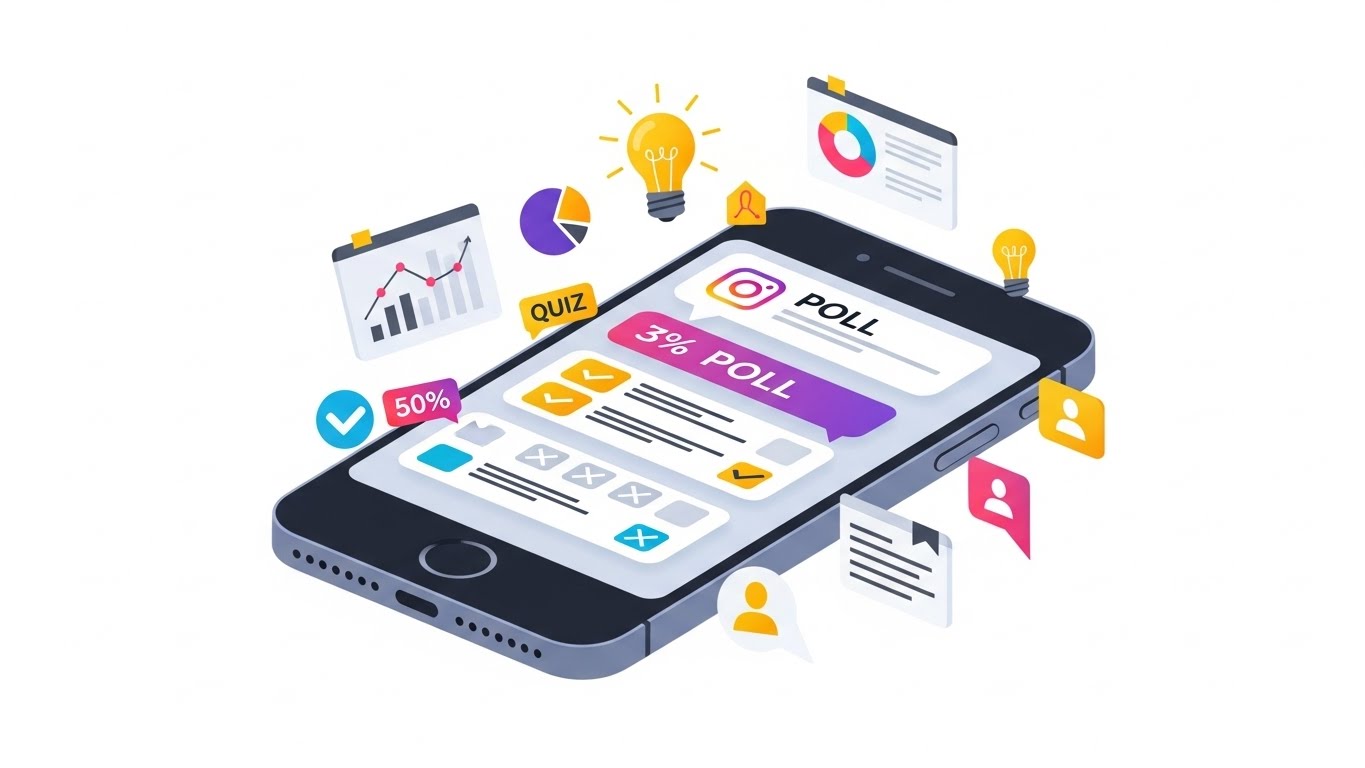
Instagram has evolved far beyond a photo-sharing platform. Today, it functions as a dynamic ecosystem for communication, branding, community-building, and—most importantly for researchers—real-time feedback. With over a billion active users worldwide, Instagram Stories have become one of the most consumed content formats in the digital landscape. ⏱️
What makes Stories unique is their interactive nature. Unlike static posts, Stories allow creators to engage directly with audiences through features such as polls, quizzes, sliders, and question boxes. Among these tools, the Poll + Quiz combo stands out as an underutilized yet remarkably effective method for research.
This article explores how researchers, marketers, educators, creators, and entrepreneurs can use Instagram’s Poll and Quiz features together to collect meaningful, actionable insights—without expensive tools or long surveys.
2. Understanding the Poll + Quiz Combo
Before diving into strategy, it’s essential to understand what each tool does individually and how they complement each other.
Instagram Poll
- Offers two (sometimes more) predefined options
- Designed for fast, low-effort responses
- Ideal for preferences, opinions, and binary choices
Instagram Quiz
- Allows multiple-choice questions
- Highlights the “correct” answer
- Encourages thinking and self-assessment
Why Combine Them?
When used together, polls gather opinions, while quizzes test knowledge or assumptions. This combination allows researchers to compare:
- What people believe
- What people prefer
- What people actually know
This contrast is incredibly valuable in behavioral, marketing, and social research. 🧠
3. Why This Combo Works Better Than Traditional Surveys
Traditional surveys often suffer from low response rates, fatigue, and poor engagement. Instagram’s Poll + Quiz combo solves many of these problems:
| Factor | Traditional Surveys | Instagram Poll + Quiz |
|---|---|---|
| Time to complete | Long | Seconds |
| Engagement | Low to medium | High 🚀 |
| Visual appeal | Minimal | Strong |
| Completion rate | Often low | Very high |
| Context | Detached | Embedded in daily habits |
Instagram users are already scrolling. Answering a poll or quiz requires almost no cognitive or time investment, making participation feel effortless.
4. Research Design for Instagram Stories
Instagram-based research still requires intentional design. Spontaneous questions may generate engagement, but structured research generates insight.
Key components of a solid research design:
- Research question(s)
- Target audience
- Variables you want to observe
- Sequence of polls and quizzes
- Data interpretation method
Unlike formal surveys, Instagram research is iterative. You can refine your questions daily based on previous responses.
5. Setting Clear Research Objectives
Every Poll + Quiz combo should serve a purpose. Before creating your Stories, ask:
- What decision will this research inform?
- What assumptions am I testing?
- What do I want to learn by the end of this Story sequence?
Example Objectives:
- Validate product-market fit
- Understand audience pain points
- Measure brand awareness
- Test content comprehension
Clarity here prevents wasted engagement and meaningless data.
6. Audience Psychology on Instagram
Instagram users behave differently than survey respondents. They are:
- Mobile-first 📱
- Visually driven
- Emotionally responsive
- Time-constrained
This affects how they interpret and answer questions. Successful research respects:
- Short attention spans
- Casual tone
- Visual cues
- Emotional framing
You are not interrupting them—you are joining their experience.
7. Crafting High-Quality Poll Questions
Polls should be:
- Simple
- Clear
- Emotionally neutral (unless intentionally framed)
Good Poll Examples:
- “Which matters more to you: Price or Quality?”
- “Do you prefer learning by video or text?”
Poor Poll Examples:
- Leading questions
- Overloaded options
- Ambiguous wording
Remember: polls measure preference, not depth.
8. Designing Insightful Quiz Questions
Quizzes introduce cognitive engagement. They work best when:
- The question challenges assumptions
- The “correct” answer teaches something
- Feedback feels rewarding 🎉
Example Quiz Use:
- Test knowledge before revealing facts
- Identify misconceptions
- Segment audiences by expertise
Quizzes are excellent for educational and awareness-based research.
9. Combining Polls and Quizzes Strategically
The real magic happens when polls and quizzes are sequenced intentionally.
Example Flow:
- Poll: “Do you think most people read terms & conditions?”
- Quiz: “What percentage actually read them?”
- Follow-up Story: Share insight or explanation
This structure reveals the gap between perception and reality—a goldmine for researchers.
10. Story Flow and Narrative Design
Instagram Stories are consumed sequentially. Use this to your advantage.
Recommended Flow:
- Context-setting Story
- Poll question
- Quiz question
- Insight or explanation
- Optional follow-up poll
This creates a mini-research narrative rather than isolated questions.
11. Visual Design Best Practices 🎨
Visual clarity directly impacts response quality.
Best Practices:
- High contrast text
- Minimal clutter
- Clear fonts
- Consistent color coding
Avoid overwhelming visuals. Your question must be instantly understandable.
12. Timing, Frequency, and Reach
Timing affects who responds.
| Factor | Recommendation |
|---|---|
| Best posting time | When audience is most active |
| Frequency | 1–3 research Stories per day |
| Duration | 24 hours (natural cutoff) |
Avoid over-surveying your audience—fatigue is real 😴.
13. Sampling Considerations and Bias
Instagram research is non-random by nature.
Common biases:
- Follower bias
- Engagement bias
- Algorithmic visibility bias
Mitigation strategies:
- Repeat questions on different days
- Compare across segments
- Use trends, not absolutes
Instagram research is directional, not definitive.
14. Data Collection and Organization
Instagram provides raw numbers, but you must organize them.
Suggested Data Table:
| Question | Option A (%) | Option B (%) | Total Responses |
|---|---|---|---|
| Poll 1 | 62% | 38% | 1,240 |
Screenshot and archive results consistently for longitudinal studies.
15. Turning Instagram Insights into Research Data
To transform engagement into research:
- Standardize question formats
- Track changes over time
- Compare similar questions
Patterns matter more than individual polls.
16. Qualitative vs Quantitative Insights
Polls = Quantitative
Quizzes = Semi-quantitative + educational
Together, they allow:
- Measurement
- Interpretation
- Contextualization
This hybrid approach is ideal for exploratory research.
17. Case Examples (Hypothetical Scenarios)
Case 1: Product Research
A startup tests pricing sensitivity using polls, then quizzes users on perceived value.
Case 2: Education
An educator quizzes students on concepts, then polls confidence levels.
Case 3: Content Strategy
A creator polls content preference, quizzes topic understanding.
18. Ethical Considerations and Transparency
Ethical Instagram research requires:
- Transparency
- No deception
- Respect for privacy
Always clarify when insights will be used commercially or academically.
19. Common Mistakes and How to Avoid Them
❌ Asking too many questions
❌ Ignoring context
❌ Overinterpreting small samples
✅ Focus on clarity
✅ Look for trends
✅ Combine methods
20. Advanced Strategies for Deeper Insights
- A/B testing different wordings
- Sequential questioning
- Segmenting by story viewers
Advanced users treat Stories as living experiments 🧪.
21. Using Poll + Quiz for Market Research
Market research benefits from:
- Rapid feedback
- Low cost
- Continuous iteration
Instagram excels at early-stage validation.
22. Using Poll + Quiz for Academic Research
While not a replacement for formal methods, Instagram can:
- Pilot hypotheses
- Test framing
- Explore perceptions
It is especially useful in communication and media studies.
23. Using Poll + Quiz for Product Validation
Before building features:
- Poll desire
- Quiz understanding
- Share implications
This reduces costly misalignment.
24. Using Poll + Quiz for UX and Content Research
Test:
- Navigation assumptions
- Feature awareness
- Content clarity
UX insights often hide in misconceptions.
25. Interpreting Results and Drawing Conclusions
Avoid absolutes. Instead, ask:
- What surprised me?
- What repeated itself?
- What changed over time?
Research is about learning, not proving.
26. Reporting and Presenting Findings
Present results visually:
- Charts
- Percentages
- Story highlights
Instagram research can live inside Instagram itself.
27. Limitations of Instagram-Based Research
- Platform dependency
- Sample bias
- Limited depth
Acknowledge these openly.
28. Future Trends in Social Media Research
Expect:
- More interactive tools
- AI-assisted insights
- Cross-platform synthesis
Instagram is just the beginning 🚀.
29. Final Checklist for Success
✅ Clear objective
✅ Simple questions
✅ Logical flow
✅ Ethical transparency
✅ Thoughtful interpretation
30. Conclusion
Instagram’s Poll + Quiz combo transforms passive audiences into active participants. When used intentionally, ethically, and creatively, it becomes a powerful research instrument—one that meets people where they already are.
In a world overloaded with surveys, Instagram offers something rare: insight without friction. 💡📱
Leave a Reply