
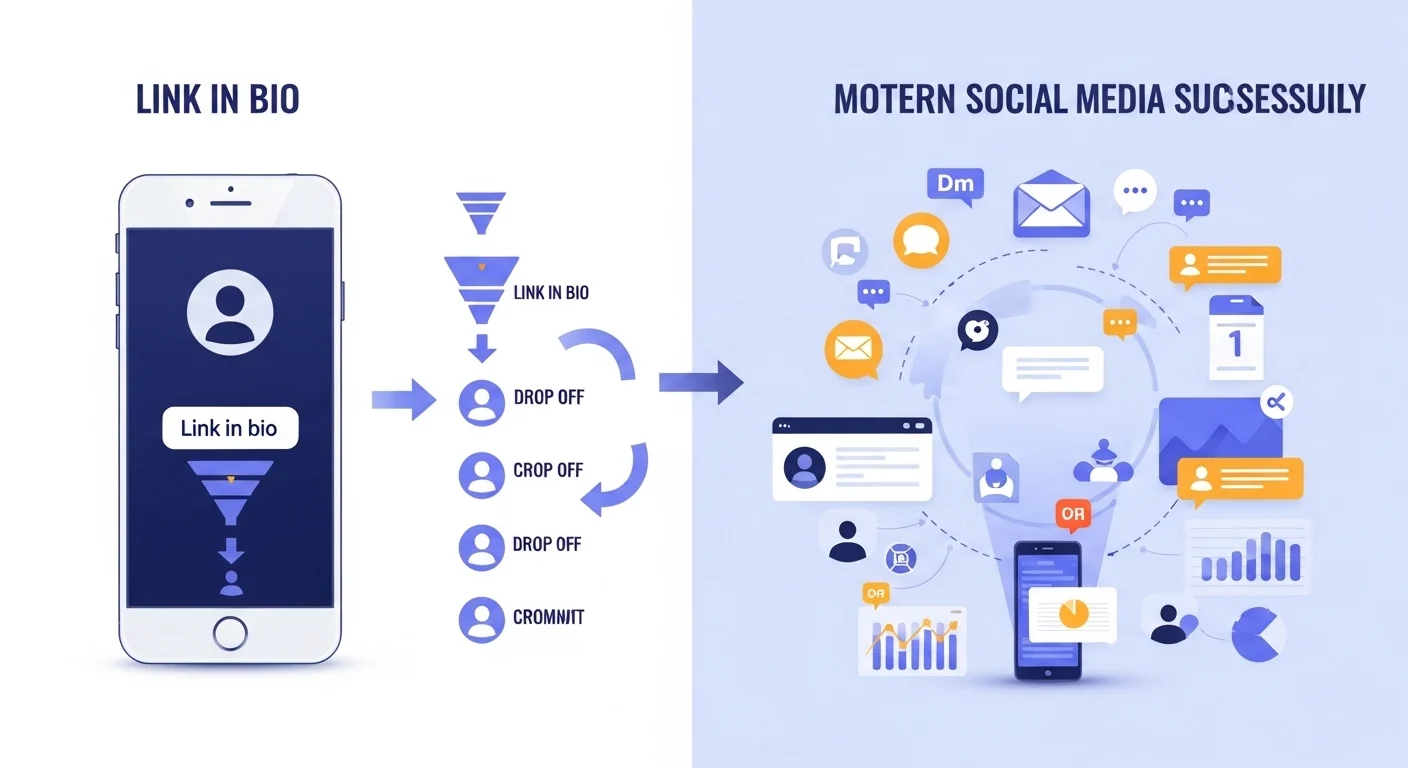
For more than a decade, the phrase “link in bio” has been a central part of social media marketing. From Instagram captions to TikTok videos, creators, brands, and influencers have relied on this strategy to drive traffic away from social platforms and toward their websites, online stores, or landing pages.
The basic idea is simple: since most social platforms allow only one clickable link in the profile, creators place their main link there and repeatedly direct followers to it with phrases like:
👉 “Link in bio.”
👉 “Check the link in my bio.”
👉 “Click the link in bio to learn more.”
Over time, entire businesses emerged to support this behavior. Platforms like link aggregators allow creators to build mini landing pages containing multiple links, giving followers several choices when they click the bio link.
But the social media ecosystem has changed dramatically.
Today:
- Platforms want users to stay inside the app
- Algorithms prioritize native interactions
- Users prefer instant experiences
- Attention spans are shorter than ever
As a result, many marketers are asking an important question:
Is the “link in bio” strategy becoming obsolete?
The short answer: not completely — but its effectiveness is declining.
In this article, we’ll explore:
- Why the link-in-bio strategy is losing effectiveness
- The behavioral psychology behind low conversions
- New alternatives that convert better
- Realistic funnel strategies for modern social media
- Tactical frameworks you can apply today
Let’s dive deep. 📊
Part 1: Why the “Link in Bio” Strategy Is Losing Power
1. Too Many Friction Steps
Conversion optimization theory teaches a simple rule:
Every extra step reduces conversions.
The traditional link-in-bio journey looks like this:
1️⃣ User sees a post
2️⃣ User reads caption
3️⃣ User decides they are interested
4️⃣ User leaves the post
5️⃣ User visits profile
6️⃣ User clicks bio link
7️⃣ User lands on a link hub page
8️⃣ User chooses a link
9️⃣ User finally reaches the destination
That’s nine steps before the user even arrives at your offer.
Each step introduces friction, doubt, or distraction.
Typical Drop-Off Funnel
| Funnel Step | User Retention |
|---|---|
| Post viewed | 100% |
| Reads caption | 70% |
| Visits profile | 25% |
| Clicks link | 12% |
| Selects link on hub | 7% |
| Arrives at offer | 5% |
This means 95% of potential conversions disappear before your offer even appears.
That’s a serious inefficiency.
2. Algorithmic Penalties
Social platforms increasingly deprioritize outbound traffic.
Why?
Because platforms make money when users stay inside the ecosystem.
Algorithms reward:
✔ comments
✔ shares
✔ watch time
✔ saves
✔ native actions
They discourage:
❌ external links
❌ traffic leaks
❌ exit behavior
This means posts aggressively pushing “link in bio” may receive lower reach.
Even when not directly penalized, they simply perform worse compared to engagement-focused content.
3. User Attention Has Changed
The average user today scrolls extremely fast.
Typical social media behavior:
- 1–2 seconds per post
- Short bursts of attention
- High distraction
Asking users to leave the feed and perform multiple steps is a heavy cognitive request.
Psychologically, people prefer:
- Immediate gratification
- Minimal effort
- Native experiences
The link-in-bio model contradicts these preferences.
4. Link Hub Overload
Many creators now use link pages containing 10–30 links.
Example:
| Link Hub Example |
|---|
| Latest YouTube Video |
| My Course |
| Free Guide |
| Podcast |
| Newsletter |
| TikTok |
| Affiliate Links |
Instead of simplifying the journey, the page creates decision paralysis.
This phenomenon is known as the Paradox of Choice.
When presented with too many options, users often choose nothing.
Part 2: The Real Problem — Intent Mismatch
The biggest weakness of the link-in-bio strategy is intent mismatch.
Users are typically in a content consumption mindset, not a buying mindset.
For example:
A person watching a funny TikTok or browsing Instagram reels is likely:
- relaxing
- killing time
- avoiding work
- looking for entertainment
Suddenly asking them to:
👉 visit your profile
👉 click a link
👉 buy a product
creates a psychological shift that most users won’t make.
Effective marketing aligns with user intent, not against it.
Part 3: Modern Alternatives That Convert Better
Instead of relying on one bio link, modern creators use multi-touch conversion ecosystems.
Let’s explore the most powerful alternatives.
1. Native Lead Magnets
The highest converting strategies capture value inside the platform.
Example methods:
✔ Comment triggers
✔ DM automation
✔ Keyword responses
✔ Interactive posts
Example:
“Comment GUIDE and I’ll send you the free checklist.”
Why this works:
- no profile visit required
- instant interaction
- algorithm boosts comments
- builds conversation
Engagement Comparison
| Strategy | Avg Engagement | Conversion Potential |
|---|---|---|
| Link in bio | Low | Medium |
| Comment trigger | High | High |
| DM automation | Very High | Very High |
2. DM Funnels
Direct messages have become one of the most powerful marketing channels on social media.
Why?
DMs feel personal.
Example funnel:
1️⃣ User comments keyword
2️⃣ Bot sends DM
3️⃣ User receives lead magnet
4️⃣ Follow-up messages deliver value
5️⃣ Offer presented later
This creates a relationship-driven conversion path.
Benefits:
✔ higher trust
✔ conversational selling
✔ personalized recommendations
3. Native Platform Shops
Many platforms now offer built-in shopping systems.
Examples include:
- Instagram Shop
- TikTok Shop
- Pinterest shopping pins
Benefits:
✔ no external website
✔ one-click purchase
✔ algorithmic support
Native commerce will likely dominate the next decade.
4. Content-to-Newsletter Pipelines
Email still converts better than most social traffic.
Instead of pushing bio links constantly, creators build content funnels that lead naturally to newsletters.
Example:
Video → curiosity → comment → DM → email signup.
Benefits:
✔ owned audience
✔ direct communication
✔ high long-term value
5. Smart Landing Pages
If you still use a bio link, it should not be a generic link hub.
Instead create a single focused landing page.
Bad example:
20 random links.
Good example:
One primary action:
✔ download guide
✔ join waitlist
✔ watch training
High Converting Bio Page Structure
| Section | Purpose |
|---|---|
| Strong headline | Clarify value |
| Short explanation | Build interest |
| Social proof | Increase trust |
| Primary button | Clear action |
| Secondary options | Optional |
Focus beats variety.
6. Micro Funnels Inside Content
Modern creators embed mini funnels directly inside posts.
Example structure:
Hook
Value
Curiosity
Engagement trigger
Example:
“Most creators lose 80% of sales because of one mistake.
Want the checklist I use? Comment CHECKLIST.”
The funnel starts before the link.
7. Long-Form Authority Content
Short-form content attracts attention.
But long-form builds authority.
Examples:
- YouTube videos
- podcasts
- deep threads
- newsletters
These formats give space to build trust and context, which dramatically increases conversions.
Part 4: Hybrid Conversion Strategy
The best strategy today is not eliminating link-in-bio, but repositioning it.
Think of it as a secondary conversion path rather than the main one.
Modern Traffic Flow
Content
   ↓
Engagement
   ↓
DM / Comment Trigger
   ↓
Lead Magnet
   ↓
Email List
   ↓
Offer
The bio link becomes support infrastructure, not the core funnel.
Part 5: Psychology of High-Converting Social Funnels
Understanding human behavior is essential.
Here are the psychological principles that power modern strategies.
1. Commitment Bias
When users take a small action (like commenting), they become more likely to take bigger actions later.
This is why comment triggers convert well.
2. Reciprocity
Giving something valuable first increases the likelihood of conversion later.
Example:
Free checklist
Free training
Free tool
3. Curiosity Gap
The human brain hates incomplete information.
Example hooks:
- “Most creators miss step #3.”
- “This mistake kills 90% of launches.”
Curiosity drives interaction.
4. Social Proof
Humans follow the crowd.
Show numbers like:
- downloads
- users
- testimonials
- success stories
Part 6: Data Comparison of Funnel Types
Below is a simplified comparison of different social media funnels.
| Funnel Type | Avg CTR | Conversion Rate | Difficulty |
|---|---|---|---|
| Link in bio | 1–2% | Low | Easy |
| Link hub | 0.8–1.5% | Low | Easy |
| Comment trigger | 5–15% | High | Medium |
| DM funnel | 8–20% | Very High | Medium |
| Native shop | 3–10% | High | Medium |
| Email funnel | 15–40% | Very High | Hard |
The difference is dramatic.
Part 7: When “Link in Bio” Still Works
Despite its weaknesses, the strategy is not completely dead.
It still works well when:
✔ audience already trusts you
✔ the offer is simple
✔ the link leads to one clear action
✔ the content is highly targeted
Example:
Creator sells a niche course.
Audience already wants it.
Then link in bio works perfectly.
Part 8: Future of Social Media Conversion
Over the next 5–10 years, we will likely see:
1️⃣ Fully Native Commerce
Purchases happening inside the app.
2️⃣ AI Conversation Funnels
Bots guiding users through personalized recommendations.
3️⃣ Creator-Owned Communities
Private platforms replacing algorithm dependency.
4️⃣ Micro-Personalization
Different users seeing different funnels based on behavior.
Part 9: Practical Strategy Framework
Here’s a modern creator funnel framework.
Step 1: Create Scroll-Stopping Content
Focus on:
✔ storytelling
✔ curiosity
✔ strong hooks
Step 2: Trigger Engagement
Use prompts like:
- comment keyword
- vote
- answer question
Step 3: Start DM Interaction
Deliver immediate value.
Example:
free PDF
template
tool
Step 4: Move to Owned Platform
Email list
community
course platform
Step 5: Offer Product
Only after trust is built.
Final Conclusion
The “link in bio” strategy is not completely dead, but its role has fundamentally changed.
In the early days of social media, it was the primary gateway to conversion.
Today, it is more like support infrastructure.
The modern social media ecosystem rewards:
✔ interaction
✔ native experiences
✔ conversation
✔ value-first marketing
Creators who rely only on bio links are leaving massive conversions on the table.
Those who embrace engagement funnels, DM automation, native commerce, and community building will outperform traditional strategies.
The key lesson is simple:
The future of social media marketing is not about links.
It’s about relationships.
Build those relationships, and conversions will follow. 🚀
Leave a Reply