
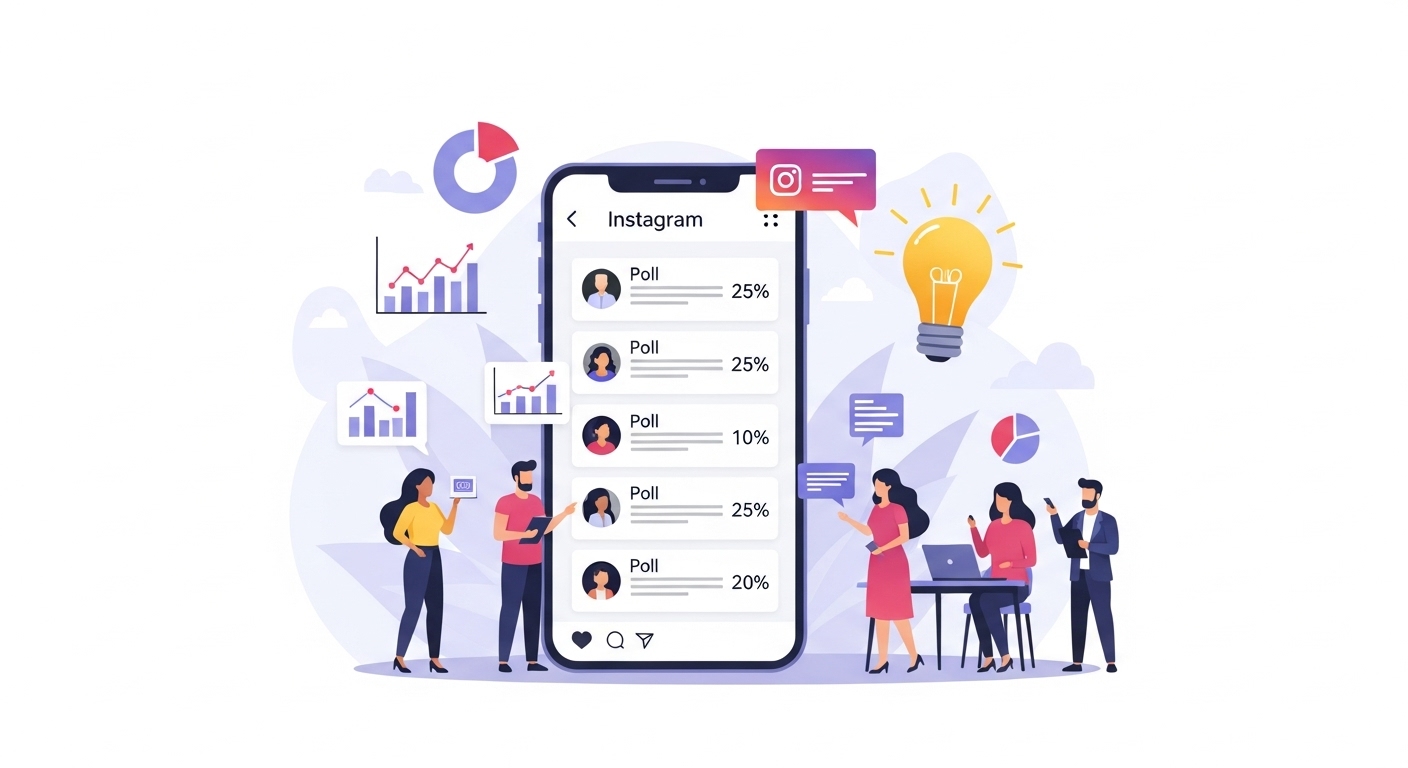
In the digital age, market research has evolved from expensive focus groups and lengthy surveys into fast, interactive, and data-rich experiences. One of the most underrated yet powerful tools for modern market research is Instagram’s Poll feature. Originally designed for engagement and entertainment, Instagram Polls have quietly become a goldmine for businesses, creators, and marketers seeking real-time consumer insights.
Instagram has over a billion active users, many of whom engage daily with Stories. Polls allow brands to tap directly into this engaged audience, asking simple questions that generate instant feedback. Unlike traditional surveys, Instagram Polls feel casual, fun, and effortless—making people more likely to participate honestly 😊.
This article explores how to use Instagram Polls strategically for market research, covering everything from psychological principles and question design to data interpretation, segmentation, limitations, and advanced tactics. Whether you’re a startup founder, digital marketer, or content creator, this guide will help you turn casual interactions into actionable insights.
Understanding Instagram Polls: A Quick Overview
Instagram Polls are interactive stickers available in Instagram Stories. They allow users to ask a question and offer two selectable answers. Viewers simply tap on their choice, and results appear instantly.
Key Characteristics of Instagram Polls
- Two response options
- Instant results
- Anonymous to participants
- Visible percentages to the creator
- High participation rates
- Available for 24 hours (Story duration)
These characteristics make polls ideal for quick, directional market research, especially in early-stage decision-making.
Why Instagram Polls Work So Well for Market Research
Instagram Polls succeed as a research tool because they align with human behavior and social media psychology.
1. Low Effort = High Participation
Traditional surveys require time and concentration. Instagram Polls require one tap. This low barrier dramatically increases response rates 👍.
2. Informal Environment Encourages Honesty
Users don’t feel like they’re being “researched.” They’re casually interacting with content, which often leads to more authentic answers.
3. Real-Time Feedback
You can see results instantly and adjust your strategy within hours instead of weeks.
4. Audience Relevance
You’re surveying people who already follow you, meaning feedback is directly tied to your target market.
When to Use Instagram Polls for Market Research
Instagram Polls are not a replacement for deep research methods, but they excel in specific scenarios.
Best Use Cases
- Product validation
- Content planning
- Pricing sensitivity
- Brand perception
- Feature prioritization
- Style and design choices
- Messaging and positioning tests
Poor Use Cases
- Complex behavioral analysis
- Detailed demographic research
- Long-form feedback
- Statistically representative studies
Understanding these boundaries is crucial to avoiding misleading conclusions 🚧.
Types of Market Research You Can Conduct with Instagram Polls
1. Exploratory Research
Use polls to discover preferences, interests, and unmet needs.
Example:
“What do you struggle with more?”
🔘 Time management
🔘 Staying motivated
2. Descriptive Research
Measure how common a preference or behavior is within your audience.
Example:
“Do you currently use a budgeting app?”
🔘 Yes
🔘 No
3. Comparative Research
Test two options against each other.
Example:
“Which logo do you prefer?”
🔘 Option A
🔘 Option B
Designing Effective Poll Questions
The quality of your insights depends on how well your questions are designed.
Principles of Strong Poll Questions
| Principle | Explanation |
|---|---|
| Clarity | Avoid vague or confusing wording |
| Brevity | Short questions perform better |
| Neutrality | Avoid leading or biased language |
| Relevance | Align with current audience interests |
| Actionability | Ensure results can inform a decision |
Good vs. Bad Poll Examples
Bad:
“Do you think our new product is innovative and affordable?”
Good:
“What matters more to you?”
🔘 Innovation
🔘 Price
Psychology Behind Poll Responses
Understanding why people choose certain answers helps interpret results more accurately 🧠.
1. Social Proof Bias
If users see a dominant answer early, they may be influenced to follow the majority.
2. Recency Effect
Answers tied to recent experiences often get more votes.
3. Emotional Framing
Emotionally charged wording can skew results.
4. Binary Limitation
Forcing two options may oversimplify nuanced opinions.
Being aware of these biases helps prevent overconfidence in results.
Segmenting Your Audience Using Polls
While polls are anonymous, segmentation is still possible through strategic posting.
Segmentation Strategies
- Post polls at different times to reach different demographics
- Use location-specific Stories
- Combine polls with question stickers
- Analyze poll results alongside Story analytics
Example Segmentation Poll Sequence
- “Are you a freelancer or business owner?”
- Follow-up poll tailored to the dominant group
This layered approach helps refine insights over time.
Using Instagram Polls for Product Development
Instagram Polls can play a vital role in product design and refinement.
Product Development Stages Supported by Polls
- Idea validation
- Feature prioritization
- Packaging design
- Pricing experiments
- Naming and branding
Feature Prioritization Example
“Which feature should we build next?”
🔘 Automation
🔘 Customization
Repeated polls over weeks help identify consistent patterns 📈.
Pricing Research with Instagram Polls
While polls can’t replace pricing studies, they are excellent for gauging sensitivity.
Pricing Poll Examples
- “Would you pay $10/month for this?”
- “Which pricing feels fair?”
- “Monthly or annual subscription?”
Pricing Insight Table
| Poll Question | Insight Gained |
|---|---|
| Price A vs B | Relative affordability |
| Free vs Paid | Perceived value |
| Monthly vs Annual | Commitment preference |
Use pricing polls early to avoid misaligned offers 💰.
Brand Perception and Positioning
Polls can reveal how your brand is perceived compared to competitors.
Brand Perception Poll Ideas
- “Which word describes us best?”
- “Who do you associate us with?”
- “Premium or practical?”
Tracking these responses over time helps measure brand evolution.
Content Strategy Research Using Polls
Content creators and brands can dramatically improve performance using poll-driven insights.
Content Research Questions
- “What do you want more of?”
- “Short or long videos?”
- “Educational or entertaining?”
Content Optimization Loop
- Ask
- Analyze
- Create
- Measure
- Repeat 🔁
This loop ensures your content stays audience-driven.
Advanced Poll Strategies for Deeper Insights
1. Sequential Polling
Ask related questions across multiple Stories.
2. Hypothesis Testing
Use polls to test assumptions before launching campaigns.
3. Trend Tracking
Repeat the same poll monthly to observe changes.
4. A/B Messaging Tests
Test two headlines or value propositions.
Analyzing Poll Data Effectively
Poll results are percentages—but interpretation requires context.
Key Metrics to Watch
- Total views
- Total votes
- Vote ratio
- Completion rate
- Drop-off points
Interpretation Table
| Scenario | What It Means |
|---|---|
| Low votes, high views | Weak question |
| High votes, split results | Polarized audience |
| One-sided result | Strong preference |
Avoid making decisions based on a single poll 🚨.
Common Mistakes to Avoid
1. Overgeneralization
Your followers ≠ entire market.
2. Leading Questions
They distort insights.
3. Excessive Polling
Too many polls reduce engagement.
4. Ignoring Context
Timing and external events matter.
Ethical Considerations in Poll-Based Research
Transparency and respect build trust.
Best Practices
- Avoid manipulation
- Don’t misrepresent results
- Respect privacy
- Use insights responsibly
Ethical research strengthens long-term brand loyalty 🤝.
Combining Instagram Polls with Other Research Methods
Polls work best when combined with other tools.
Complementary Methods
- Email surveys
- Customer interviews
- Website analytics
- Sales data
- Customer support feedback
Research Stack Example
| Tool | Purpose |
|---|---|
| Instagram Polls | Quick insights |
| Surveys | Detailed feedback |
| Interviews | Emotional depth |
| Analytics | Behavioral data |
Measuring ROI of Instagram Poll Research
While intangible, ROI can be inferred.
ROI Indicators
- Reduced product failures
- Higher engagement rates
- Better conversion rates
- Faster decision-making
- Increased customer satisfaction
Market research doesn’t always save money—it prevents costly mistakes 💡.
Limitations of Instagram Polls
Despite their power, polls have limitations.
Key Limitations
- Binary answers only
- Sample bias
- Short lifespan
- No demographic breakdown
- Influenced by design and timing
Recognizing these limits keeps expectations realistic.
Future of Instagram Polls in Market Research
As social platforms evolve, interactive research will become more sophisticated.
Potential Developments
- Multi-option polls
- Deeper analytics
- AI-driven insights
- CRM integrations
- Predictive modeling
Brands that master these tools early gain a competitive advantage 🚀.
Practical Case Example (Hypothetical)
A fitness brand wants to launch a new program.
Poll Sequence
- “What’s your main fitness goal?”
- “Home or gym workouts?”
- “Live coaching or recorded videos?”
- “Monthly or one-time payment?”
Within 48 hours, the brand gathers insights that would otherwise take weeks—guiding product design with confidence.
Final Thoughts: Turning Engagement into Intelligence
Instagram Polls are far more than engagement tools—they are mini research engines hidden in plain sight. When used thoughtfully, they provide fast, affordable, and actionable insights directly from your audience.
The key is intentionality:
- Ask better questions
- Analyze beyond percentages
- Combine with other data
- Respect limitations
Market research doesn’t have to be complex to be powerful. Sometimes, all it takes is a simple tap on a Story 📲✨.
Leave a Reply