
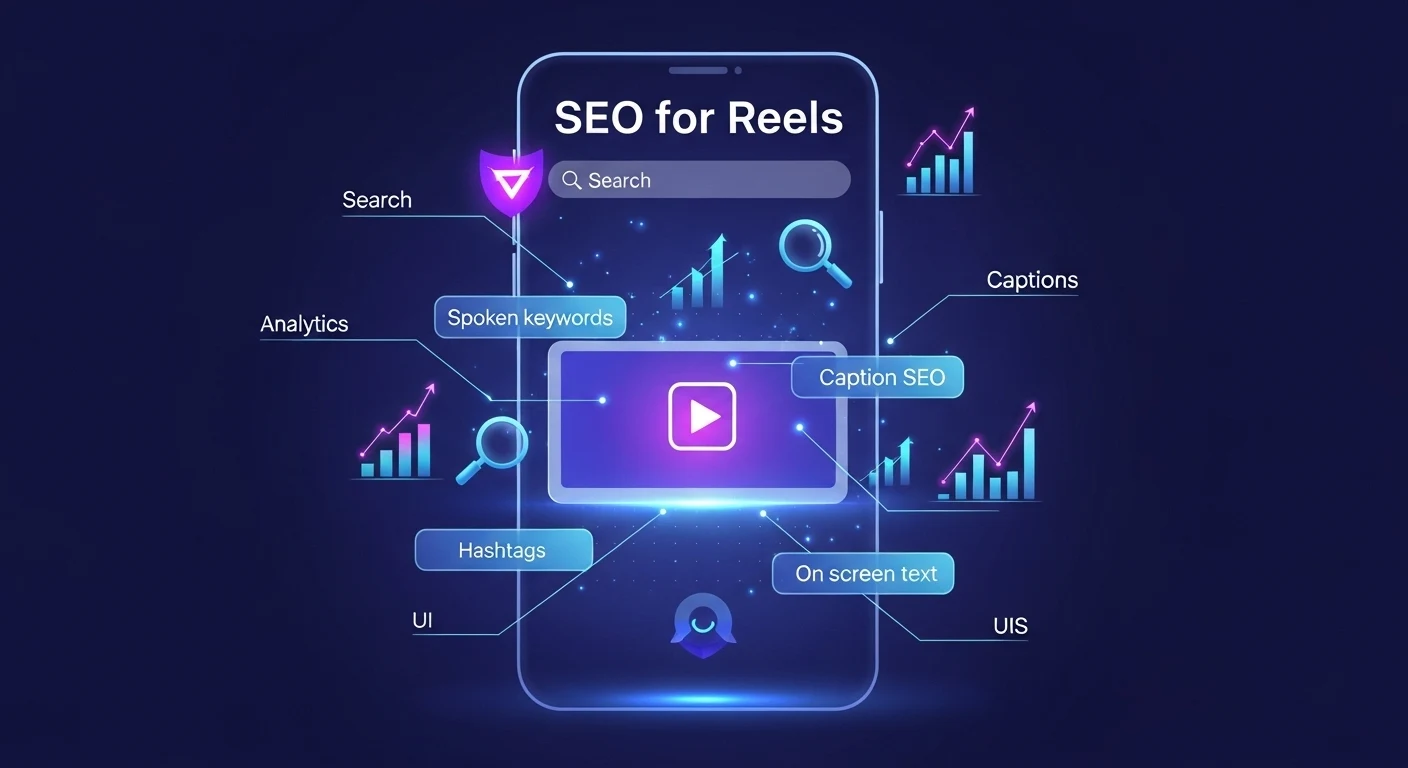
Short-form vertical video has transformed the way content is discovered and consumed. Platforms like Instagram, TikTok, and YouTube have trained users to scroll fast, engage quickly, and decide in seconds whether a piece of content deserves attention.
But while creativity drives engagement, searchability drives sustainability.
If your Reels aren’t optimized for search, you’re leaving long-term visibility on the table. Viral moments fade. Indexed content compounds.
This guide dives deep into SEO for Reels, focusing specifically on where to place keywords to be found. We’ll explore strategic placement, algorithmic behavior, semantic indexing, and practical workflows you can implement today.
Table of Contents 📚
- Understanding How Reels Are Indexed
- Why Keyword Placement Matters
- Primary vs Secondary Keywords
- The 10 Key Places to Insert Keywords
- On-Screen Text Optimization
- Captions & Semantic Depth
- Hashtags: Strategy vs Stuffing
- Audio and Voice SEO
- Profile-Level SEO Signals
- Engagement Signals & Keyword Reinforcement
- Common Mistakes
- Advanced Optimization Techniques
- SEO Workflow for Every Reel
- Metrics to Track
- Future of Search in Short-Form Video
- Final Checklist
1. Understanding How Reels Are Indexed 🔎
Reels are no longer purely entertainment-driven. They are searchable assets.
Modern social algorithms use:
- Text recognition (OCR on screen)
- Speech-to-text transcription
- Caption analysis
- Hashtag mapping
- Engagement pattern recognition
- Topic clustering
- User behavior history
This means the platform reads:
- What you write
- What you say
- What appears visually
- What your audience does
If your Reel is about “beginner yoga stretches,” but you never say or write those words, you are invisible to that search query.
Search engines within social platforms are increasingly functioning like mini versions of traditional search engines. The parent company of Instagram, Meta Platforms, has publicly emphasized AI-driven discovery and search expansion.
Search is no longer optional.
2. Why Keyword Placement Matters 🎯
Many creators believe that simply adding hashtags is enough.
It’s not.
Search ranking in Reels is influenced by:
| Ranking Factor | Importance | Why It Matters |
|---|---|---|
| Spoken keywords | ⭐⭐⭐⭐⭐ | Transcribed and indexed |
| On-screen text | ⭐⭐⭐⭐ | OCR-readable |
| Caption keywords | ⭐⭐⭐⭐⭐ | Core metadata |
| Hashtags | ⭐⭐⭐ | Categorization signal |
| Engagement | ⭐⭐⭐⭐⭐ | Reinforces topic relevance |
| Saves & Shares | ⭐⭐⭐⭐ | Longevity signal |
The more aligned signals your Reel sends about a topic, the more confidently the algorithm categorizes it.
Think of SEO for Reels like building a case in court. One keyword mention is weak evidence. Five aligned signals? Strong conviction.
3. Primary vs Secondary Keywords 🧠
Before discussing placement, understand structure.
Primary Keyword
Your main search phrase.
Example:
“High protein breakfast ideas”
Secondary Keywords
Supporting variations:
- Healthy breakfast
- Protein meal prep
- Easy breakfast recipes
- Muscle gain meals
Long-Tail Keywords
Specific phrases:
- High protein breakfast under 400 calories
- High protein vegetarian breakfast ideas
Strong Reels use:
- 1 primary keyword
- 3–5 secondary variations
- 1–2 long-tail phrases
This prevents repetition while strengthening topic authority.
4. The 10 Key Places to Insert Keywords 📍
Here’s where keywords should live.
1️⃣ Hook (Spoken)
The first 3 seconds are crucial.
Say your primary keyword clearly:
❌ Weak:
“Let me show you something cool.”
✅ Strong:
“Here are three high protein breakfast ideas that actually keep you full.”
Speech is transcribed automatically.
If you don’t say it, you limit visibility.
2️⃣ On-Screen Hook Text
Add bold, readable text:
HIGH PROTEIN BREAKFAST IDEAS 🥑
The platform reads this via OCR.
Tip: Keep font clean and high contrast.
3️⃣ Caption First Line
The first line is prime SEO real estate.
Example:
High protein breakfast ideas for busy mornings 💪
Why? Because platforms often prioritize early caption text in indexing.
4️⃣ Caption Body
Use natural language:
Instead of:
#protein #breakfast #healthy
Write:
These high protein breakfast ideas are perfect if you’re trying to build muscle, lose weight, or stay full longer.
Context matters more than repetition.
5️⃣ Hashtags
Use structured strategy:
| Type | Example | Quantity |
|---|---|---|
| Primary | #HighProteinBreakfast | 1 |
| Secondary | #HealthyBreakfast | 2–3 |
| Niche | #ProteinMealPrep | 1–2 |
| Broad | #FitnessTips | 1–2 |
Total sweet spot: 5–8 hashtags.
Avoid 30 random tags.
6️⃣ On-Screen Subtitles
If you use captions/subtitles, ensure they include keywords.
Instead of:
“These are so good!”
Say:
“This is one of my favorite high protein breakfast ideas.”
Repetition across formats strengthens indexing.
7️⃣ File Name (Optional but Smart)
Before uploading:
Instead of:
VID_00234.mp4
Rename:
high-protein-breakfast-ideas.mp4
It’s a small signal, but professional workflows include it.
8️⃣ Cover Text
Your Reel cover matters for:
- Profile grid SEO
- Explore visibility
- External link previews
Add keyword phrase in cover design.
9️⃣ Alt Text (If Available)
Some platforms allow accessibility descriptions.
Example:
A video showing three high protein breakfast recipes with ingredients and macros.
This strengthens discoverability and accessibility ♿
🔟 Profile Bio & Highlights
If you consistently post about one niche, your bio should reflect it.
Example:
Helping you build muscle with high protein recipes 🍳
Topic authority compounds across posts.
5. On-Screen Text Optimization 🖥️
On-screen text must:
- Be legible
- Stay long enough to be read
- Not be hidden behind interface elements
Best Practices:
| Element | Recommendation |
|---|---|
| Font | Clean sans-serif |
| Size | Large enough for mobile |
| Contrast | High contrast background |
| Duration | 3–5 seconds minimum |
| Placement | Avoid bottom caption overlap |
Don’t overload screen with paragraphs. Keep it scannable.
6. Caption Strategy: Depth Over Density ✍️
Keyword stuffing is outdated.
Instead of:
High protein breakfast high protein breakfast healthy protein breakfast.
Use semantic layering:
If you struggle to stay full in the morning, these high protein breakfast ideas will change your routine. Each recipe has at least 30 grams of protein and takes under 10 minutes.
Natural language improves topic clustering.
Algorithms understand related terms like:
- Protein
- Muscle
- Macros
- Meal prep
- Calories
- Nutrition
Use semantic variety.
7. Hashtags: Categorization, Not Ranking ⚙️
Hashtags are secondary signals now.
They:
- Categorize content
- Help niche discovery
- Assist initial distribution
They do not compensate for missing spoken keywords.
Avoid:
- Irrelevant trending tags
- Massive generic tags (#love, #fun)
- Overloading 20+ hashtags
Relevance beats volume.
8. Audio & Voice SEO 🎙️
Speech-to-text indexing is powerful.
Speak clearly:
- Avoid mumbling
- Avoid heavy background noise
- Use direct phrases
Example:
❌ Weak:
“This works great.”
✅ Strong:
“This high protein breakfast is perfect for fat loss.”
The exact phrase strengthens ranking.
9. Profile-Level SEO Signals 👤
Consistency builds authority.
If 20 of your last 30 Reels contain “high protein recipes,” the platform categorizes your account accordingly.
Strong Niche Profile Example:
| Section | Optimization |
|---|---|
| Username | @HighProteinCoach |
| Bio | High protein meal ideas daily |
| Highlights | Protein Tips |
| Pinned Reels | Top protein recipes |
Authority increases discoverability over time.
10. Engagement Reinforces Keywords 🔁
Engagement tells the algorithm:
“This content satisfies this search intent.”
Encourage comments using keyword prompts:
Comment “PROTEIN” if you want the full recipe.
When users comment related terms, it strengthens topical association.
Saves and shares are even more powerful than likes.
11. Common SEO Mistakes ❌
1. Not Saying the Keyword
Silent B-roll without narration limits indexing.
2. Keyword Only in Hashtags
Too weak alone.
3. Overstuffing Caption
Looks spammy.
4. Using Unrelated Trending Audio
Topic confusion reduces ranking clarity.
5. Changing Niche Constantly
Algorithm cannot categorize you.
12. Advanced Optimization Techniques 🧩
Now let’s go deeper.
A. Keyword Stacking Across Formats
Repeat keyword across:
- Spoken intro
- On-screen hook
- Caption first line
- Hashtags
- Cover text
Not aggressively. Strategically.
B. Topic Clusters
Instead of random posts, create clusters:
Week 1:
- High protein breakfast
- High protein lunch
- High protein snacks
Week 2:
- Vegetarian high protein breakfast
- Budget high protein meals
Clustered content strengthens search presence.
C. Search Intent Matching
There are three main search intents:
| Intent Type | Example | Strategy |
|---|---|---|
| Informational | How to cook quinoa | Tutorial format |
| Comparative | Oats vs eggs protein | Side-by-side format |
| Transactional | Best protein powder | Review format |
Align content structure with intent.
D. Question-Based Hooks
Searchers often type questions.
Use:
- “How to…”
- “Best way to…”
- “Why does…”
Example:
How to make a high protein breakfast in 5 minutes.
This directly mirrors search behavior.
13. SEO Workflow for Every Reel 🛠️
Use this repeatable process.
Step 1: Keyword Research
Search inside platform search bar.
Note autofill suggestions.
Step 2: Choose:
- 1 primary
- 3 secondary
Step 3: Script With Intent
Include keyword in:
- First sentence
- Mid explanation
- Closing CTA
Step 4: Design On-Screen Hook
Step 5: Write Caption
Natural, layered language.
Step 6: Add Structured Hashtags
Step 7: Optimize Cover
Step 8: Monitor Metrics
14. Metrics to Track 📊
SEO performance is different from viral performance.
Look at:
| Metric | What It Indicates |
|---|---|
| Reach from Search | Direct SEO success |
| Saves | Value depth |
| Shares | Distribution power |
| Avg Watch Time | Content quality |
| Profile Visits | Authority building |
| Follows | Conversion power |
High search reach = correct keyword placement.
15. The Future of Search in Short-Form Video 🔮
Search inside social platforms is expanding.
Users now:
- Search recipes
- Search workouts
- Search tutorials
- Search reviews
Short-form video is becoming a search engine.
Creators who understand keyword placement now will dominate later.
Expect:
- Stronger AI topic detection
- Voice indexing improvements
- Semantic understanding expansion
- Reduced reliance on hashtags
Search-first content will outperform trend-chasing content long term.
16. Ultimate Keyword Placement Checklist ✅
Before posting, confirm:
☐ Primary keyword spoken in first 3 seconds
☐ Primary keyword in on-screen hook
☐ Keyword in caption first line
☐ Semantic variation in caption body
☐ 5–8 relevant hashtags
☐ Keyword visible on cover
☐ Clear subtitles
☐ Strong niche alignment
☐ Engagement prompt connected to topic
If you check 8+ boxes, your Reel is optimized.
Final Thoughts 💡
SEO for Reels is not about gaming the algorithm.
It’s about clarity.
When the platform clearly understands:
- What your content is about
- Who it’s for
- What problem it solves
It can confidently show it to the right people.
The formula is simple:
Clarity + Consistency + Keyword Alignment = Discoverability
Viral spikes are exciting.
Search traffic is predictable.
Compounding visibility builds businesses.
If you treat every Reel like an indexed asset instead of disposable content, you build a discoverable content library that works for you long after you post it.
And in a world of endless scrolling, being searchable is power. 🔥
Leave a Reply